Flex Space for Distributors and Wholesalers: The Right-Sized Model for Regional Inventory Businesses
Why Distributors Outgrow the Traditional Real Estate Options
Independent distributors, wholesalers, importers, and regional sales reps occupy an awkward middle ground in the commercial real estate market. Their businesses run on physical inventory that has to be received, stored, picked, and re-shipped, which means they need genuine warehouse volume, a loading area, and clearance for racking and pallets. At the same time, they run a real business behind that inventory: purchasing, sales, customer service, accounting, and vendor management that all require a professional office environment. The traditional market pushes these companies toward one of two poor fits.
On one end sits pure office space, which offers no room to stage inventory, no dock access, and no tolerance for forklifts or pallet jacks. On the other end sits the large distribution center, engineered for national fulfillment operations moving thousands of orders a day. That kind of facility comes with square footage, ceiling heights, dock counts, and lease terms scaled for enterprises many times the size of a growing regional distributor. Signing a lease on a 100,000-square-foot bulk warehouse to run a business that needs a fraction of that space is a fast way to bury margin under rent you cannot fill.
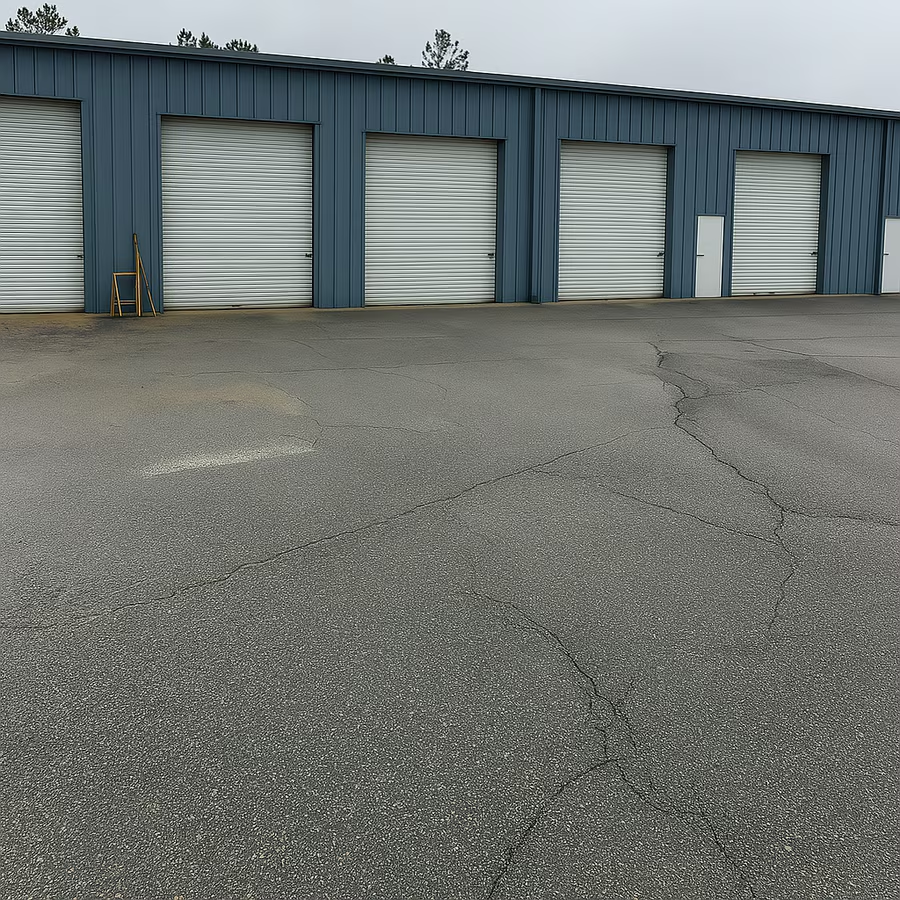
Flex space resolves this tension directly. A flex unit blends warehouse and office under a single roof and a single lease, giving distributors the receiving and re-shipping capacity they actually use alongside a front office their team and customers can work from. It is built for the business that is too big for a spare room and too lean for a mega-distribution center. For the independent operator scaling a product line across a region, that middle ground is not a compromise. It is the correct footprint.
One Unit for Receiving, Warehousing, and Re-Shipping
The daily rhythm of a distribution business is a loop: inventory comes in, it gets stored, orders get picked, and product goes back out. A flex unit is designed to hold that entire loop in one place. The warehouse portion provides the open floor and vertical volume to receive inbound freight, stage it, rack it, and organize it by SKU or product line. Shipping and receiving happen on-site, so a company can accept truckloads from suppliers or importers and turn around outbound orders to customers without shuttling inventory between separate locations or paying a third party to hold it.
The office portion of the same unit is where the rest of the business lives. Purchasing teams place orders and manage supplier relationships, sales reps quote and close, customer service handles accounts, and administrators run the books, all steps from the inventory they are selling. That proximity matters more than it sounds. When the person answering a customer's stock question can walk to the shelf and confirm the count, when a sales rep can pull a sample for a walk-in buyer, when the owner can see the whole operation from receiving dock to front desk, the business runs tighter and mistakes get caught faster.
Consolidating everything under one lease also simplifies the economics and the logistics. Instead of paying rent, utilities, and insurance on a separate warehouse and a separate office, and instead of managing two leases with two landlords on two renewal schedules, a distributor holds a single agreement covering the whole operation. That reduces overhead, cuts the friction of coordinating between sites, and gives the owner a clearer picture of what the space actually costs relative to the throughput it supports. For a lean team, removing that administrative drag frees up time and attention for the work that grows the business.
A Network of Distribution Points Near Highways and Metros
For any distributor, location is not a vanity concern. It determines how quickly and cheaply product reaches customers, and in ground shipping, geography is destiny. A package's transit time and cost are driven largely by how far it has to travel and how many zones it crosses. A distributor positioned near a major highway corridor and a metropolitan market can reach a wide swath of customers within one- to two-day ground zones, which lowers freight costs, shortens delivery windows, and makes the business more competitive against larger rivals shipping from farther away.
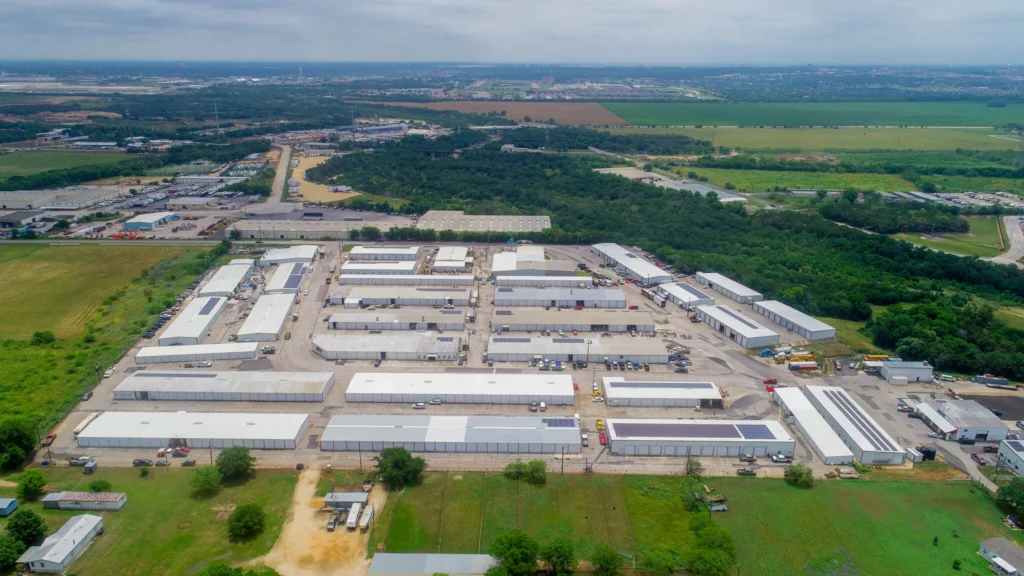
Forward Business Park operates flex space across a footprint spanning Georgia, Texas, Ohio, Michigan, Illinois, New York, Missouri, Alabama, and Arkansas. That spread is not incidental to the distribution use case. It functions as a set of well-positioned distribution points anchored in major regional markets and near the highway systems that move ground freight across the country. A wholesaler serving the Southeast can base out of a market in Georgia or Alabama; one serving the industrial Midwest can plant in Ohio, Michigan, or Illinois; one covering the South Central region can work from Texas, Missouri, or Arkansas. Each location puts inventory closer to the customers it serves.
That geographic reach also opens a path for distributors thinking beyond a single territory. A business that starts in one market and wants to extend its ground-shipping reach into an adjacent region can expand into a second Forward Business Park location rather than trying to stretch delivery zones from a single overtaxed hub. Establishing a forward inventory position in a new metro can turn a two- or three-day shipment into a next-day one, which changes what a distributor can promise its customers. A common flex model across markets means the operational template that works in one location can be replicated in the next, letting a growing distributor build out a small network of well-placed inventory points on terms it already understands.
Right-Sizing as Your Product Lines and Inventory Grow
Distribution businesses rarely stand still. A new supplier relationship, an added product category, a seasonal build, or an expansion into a new customer segment can change how much space a company needs, sometimes quickly. The trouble with committing to a large fixed facility early is that it forces a distributor to pay today for space it hopes to fill tomorrow, betting rent against growth that has not arrived yet. The trouble with committing to too little is the opposite: outgrowing the space mid-season and scrambling for room to hold inventory the business has already bought.
The flex model is built to move with the business rather than against it. A distributor can take the footprint that fits current inventory and order volume, then adjust as product lines expand and throughput climbs. Right-sizing over time means capital stays in inventory, hiring, and customer acquisition, where it compounds, rather than being locked into warehouse square footage sitting empty against a forecast. For a company managing the working-capital tightrope that every inventory business walks, matching space to actual need is not just convenient. It protects margin.
Growing With Forward Business Park
The distributors and wholesalers who thrive are the ones whose real estate keeps pace with their business instead of dictating it. Forward Business Park is built for exactly that trajectory. Flexible lease terms let a growing inventory business commit to what it needs now while keeping room to adjust, so a distributor is never trapped paying for space it cannot fill or boxed in by space it has outgrown. As product lines multiply and order volume climbs, tenants can right-size over time, expanding their footprint or stepping into a larger unit without abandoning the operating model that got them there.
The combined office-and-warehouse format also gives a distribution business something a bare warehouse never can: a professional image. Customers, suppliers, and reps who visit see a real operation, a front office and an organized inventory floor under one roof, which builds the credibility that wins accounts and holds them. And because Forward Business Park operates a common flex model across markets in Georgia, Texas, Ohio, Michigan, Illinois, New York, Missouri, Alabama, and Arkansas, a distributor is not tied to a single building. It is part of a network that can support expansion into new regions on familiar terms, turning today's single location into tomorrow's multi-market distribution footprint.
If you are receiving, warehousing, and re-shipping inventory while running the sales and admin side of the business, and you are tired of forcing that operation into space that fits only half of it, Forward Business Park has a better model. Reach out to learn how flex space can consolidate your operation, position your inventory closer to your customers, and grow with you as your business scales across markets.