Flex Space for E-Commerce and Fulfillment Businesses
Every successful e-commerce business eventually reaches the same crossroads. What started as a side hustle run out of a spare bedroom, a garage, or the corner of a living room has grown into a real operation — one with pallets of inventory arriving faster than the shelves can hold, packing tables squeezed between the car and the water heater, and a delivery driver who now knows the front door by heart. The business is working. The problem is that the space isn't. When inventory starts spilling into the hallway and every inbound shipment triggers a scramble for room, the garage has stopped being a launchpad and started being a ceiling. That's the moment a growing online seller needs a real home — and it's exactly the moment flex space makes sense.
When the Garage Stops Working The transition out of a home-based setup is rarely a single decision. It creeps up as a series of small frustrations that eventually become impossible to ignore. Inbound shipments have nowhere to land, so cartons stack in the driveway until they can be broken down. Returns pile up with no dedicated area to process them. A seasonal order surge means renting a storage unit across town, then driving back and forth to pick and pack, because the inventory and the shipping station are no longer in the same place. Each workaround costs time, and time is the one resource a lean e-commerce operation cannot spare.
The instinct at this stage is often to jump straight to a traditional warehouse. But most standalone warehouse leases are built for operations far larger than a growing online seller — tens of thousands of square feet, multi-year commitments, and a rent bill that assumes a volume the business hasn't reached yet. Signing that kind of lease to solve a space problem can create a much bigger cash-flow problem. What the business actually needs is something in between: more room than a garage, less overhead than a distribution center, and the ability to run the entire operation — receiving, storage, fulfillment, and the office work that ties it together — under a single roof and a single lease. That in-between is precisely what flex space is designed to be.
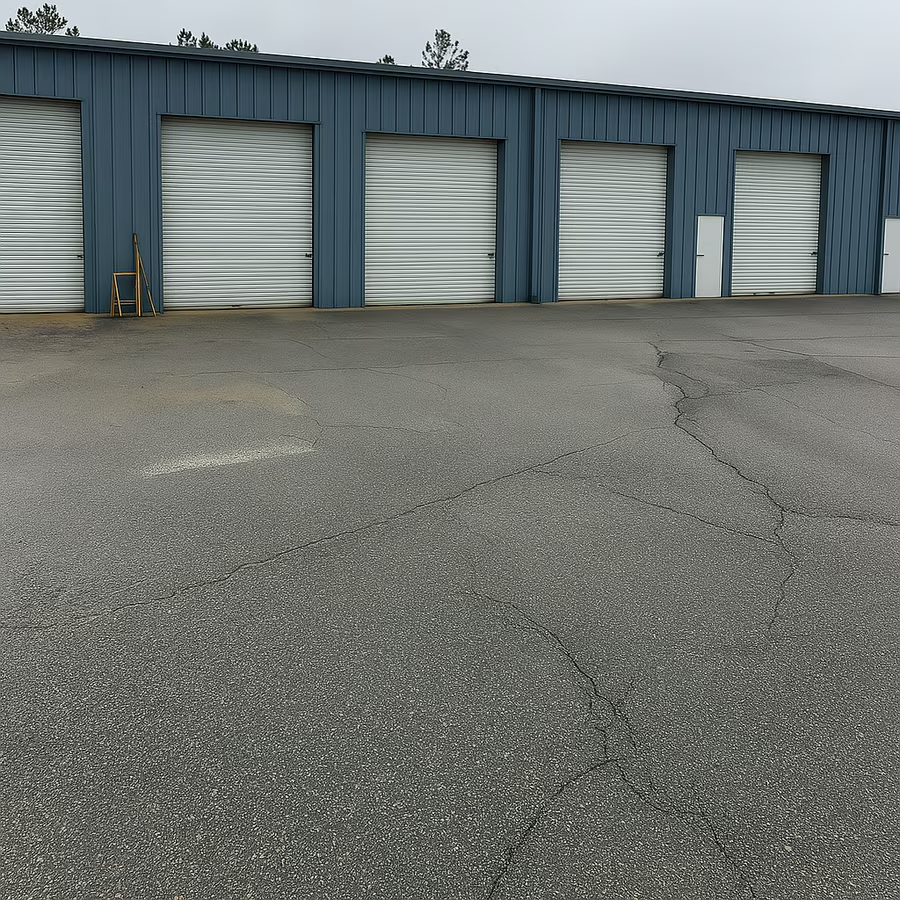
One Roof for Receiving, Storage, and Ship-Out Flex space combines warehouse and office into one adaptable unit, and for an e-commerce or fulfillment business that combination maps almost perfectly onto how the work actually flows. Inbound freight arrives at the warehouse side, where there's room to receive, inspect, and shelve inventory without blocking anything else. From there, the same unit holds a dedicated pack-and-ship station — a place where orders can be picked, boxed, labeled, and staged for carrier pickup without competing for the kitchen table. Returns get a defined area instead of an ever-growing pile. And the office portion gives the business a real desk for customer service, bookkeeping, and the day-to-day administration that keeps orders moving.
Having all of this in one place is more than a convenience — it's an efficiency multiplier. When receiving, storage, fulfillment, and administration share a footprint, there's no driving between a storage unit and a home office, no losing track of inventory across two locations, no wasted motion. Orders go out faster because everything the operation touches is within a few steps. Just as important, a proper commercial space signals that the business has grown up. Suppliers ship to a real dock, carriers pick up on a predictable schedule, and the owner can finally separate the business from the house — a boundary that matters as much for sanity as for logistics.
Scaling Through Peaks Without Overcommitting E-commerce rarely grows in a straight line. A viral product, a holiday rush, a marketing campaign that lands — any of these can double order volume in a matter of weeks, and then volume settles back to a new baseline. The challenge is sizing a space for a business whose footprint changes with the season. Commit to too much room and you're paying for empty square footage most of the year. Commit to too little and the next peak buries you all over again. This is the exact bind flex space is built to solve, because it lets an operator right-size the footprint rather than lock into a fixed guess.
At Forward Business Park, that means starting in a unit that fits today's volume and moving into more space as the business grows — without the friction of breaking a long-term warehouse lease. A seller can take on enough room to handle a busy fourth quarter, then evaluate whether that footprint makes sense for the year ahead. Flexible terms mean the space adapts to the business rather than forcing the business to adapt to the space. For a growing seller, that elasticity is the difference between capacity being an asset and capacity being a liability — you scale into demand instead of paying ahead of it or scrambling behind it.
Distribution Points That Put You Closer to the Customer For online sellers, location is a competitive weapon. Shipping speed and shipping cost are two of the biggest factors customers weigh, and both are driven by how far a package has to travel from the shelf to the doorstep. A fulfillment operation positioned near major highways and carrier routes gets orders into the network faster and reaches more customers within one- and two-day ground zones — which lowers shipping costs and raises the odds of the repeat purchase. Proximity to the logistics backbone isn't a nice-to-have for e-commerce; it's part of the margin.
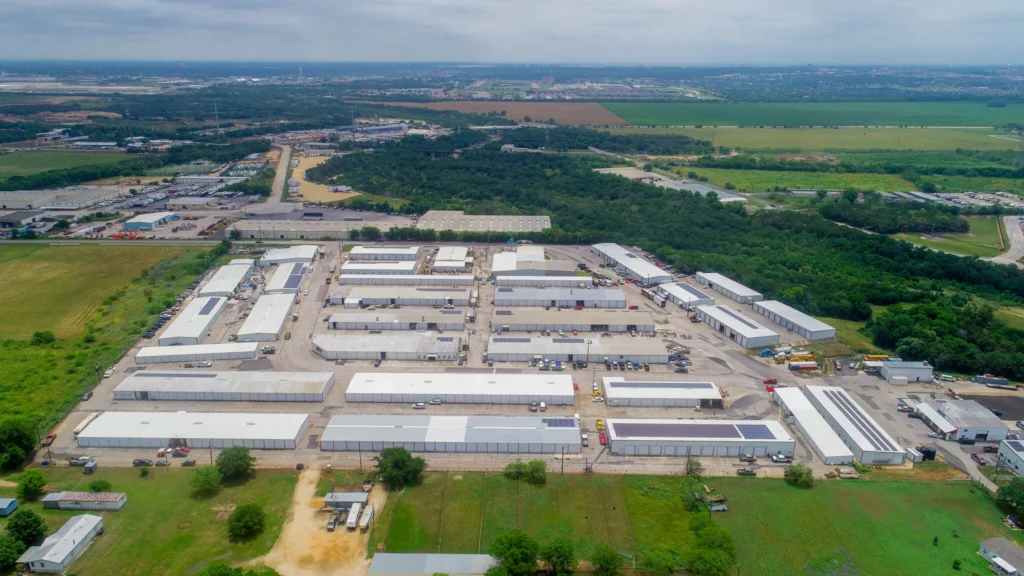
This is where Forward Business Park's footprint becomes a genuine advantage for national sellers. With flex-space properties across Georgia, Texas, Missouri, Ohio, Michigan, Illinois, New York, Alabama, and Arkansas, FBP offers well-positioned distribution points spread across the country rather than concentrated in a single region. A seller can establish fulfillment where it does the most good — closer to a growing customer base, nearer to a supplier, or positioned to cover a region a single location can't reach economically. And because every FBP market runs on the same flexible, office-warehouse model, a business expanding from one location to several finds a consistent, dependable footing in each new market rather than reinventing its logistics from scratch. Whether you're graduating out of the garage or opening your second and third fulfillment point, our leasing team can help you find the right fit — contact us to schedule a tour and see how flex space can grow with your business.